
What is carbon capture and storage (CCS)?
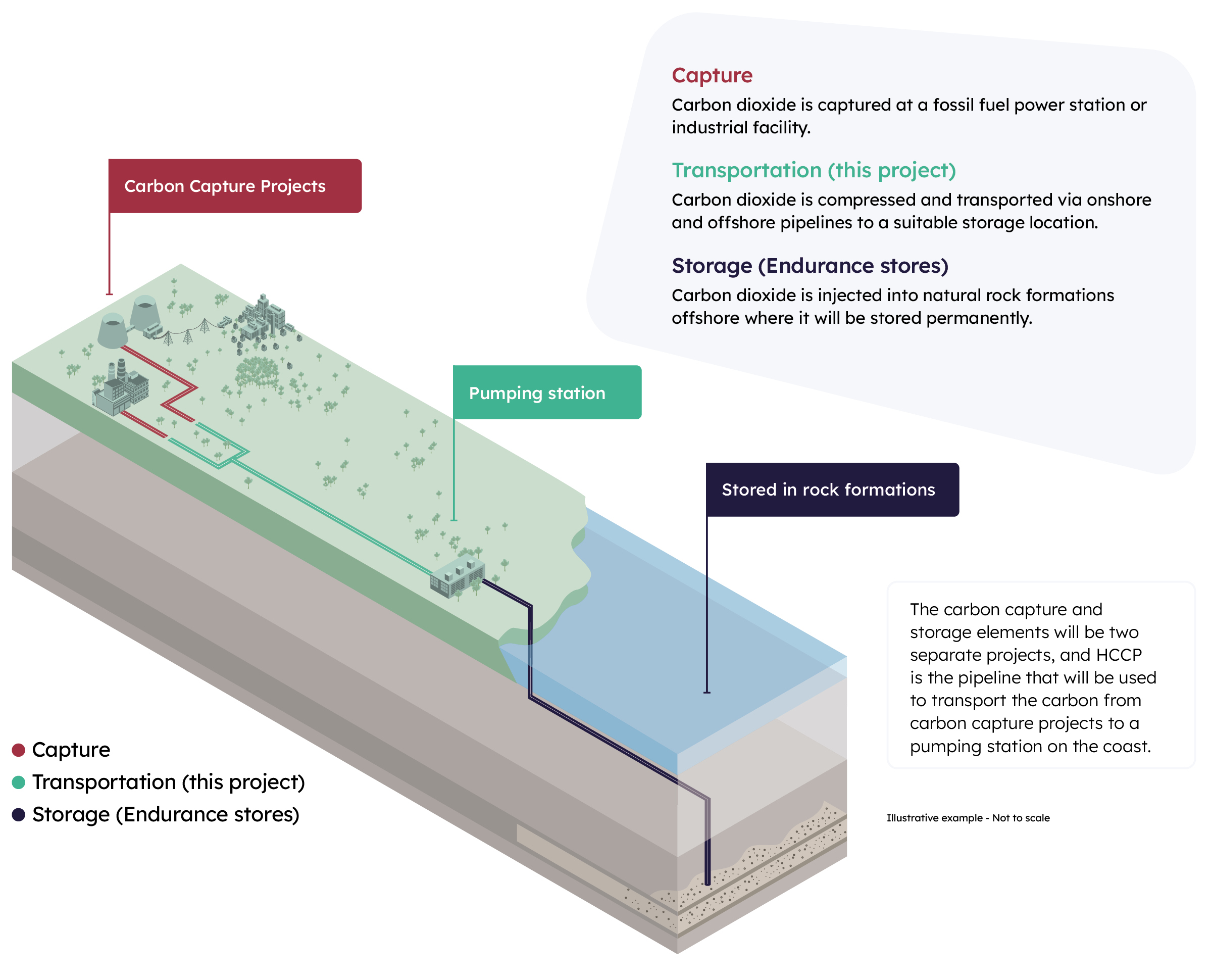
Carbon Capture and Storage (known as CCS) is a process which captures carbon dioxide emissions from industrial processes and power generation and transports them to secure storage areas.
Several industrial sites in the Humber region are developing plans to capture their carbon dioxide emissions, and we anticipate other carbon capture projects are likely to come forward soon.
The Humber Carbon Capture Pipeline is an essential part of carbon capture and storage on the Humber and would provide the onshore infrastructure required to transport the carbon dioxide captured from industrial sites to secure storage.
The carbon dioxide would be permanently stored in geological formations under the North Sea (known as the Endurance and expansion stores). The offshore transportation infrastructure and storage facility is subject to a different consenting process.
How does carbon capture and storage (CCUS) work?
Government policy and the energy transition
Carbon Capture and Storage is critical to the UK’s Net Zero Strategy and is fundamental as part of a wider strategy for reducing emissions from traditional industries and power producers.
The Government's overarching National Policy Statement for Energy confirms that there is an urgent need for new Carbon Capture and Storage infrastructure to support the transition to a net zero economy. As such, as a matter of planning policy the need for schemes such as this is established.
Options for decarbonising industries like these are currently limited and, in some cases, fuel switching (which may itself take time) can only partially decarbonise industry. Carbon Capture and Storage therefore has an important part to play during a period of energy transition. It offers an opportunity to enable important industries to continue production and to support local jobs, whilst also reducing greenhouse gas emissions and ensuing energy security.